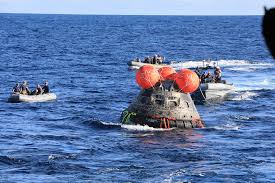
Four astronauts made a triumphant return to Earth on Friday night, concluding a groundbreaking 10-day lunar voyage that represented humanity's first journey to the Moon's vicinity in more than five decades. The Artemis II mission ended with a flawless Pacific Ocean splashdown, advancing NASA's ambitious plans for future lunar exploration.
Mission commander Reid Wiseman reported that the entire four-person crew remained in excellent health as their Orion capsule, dubbed "Integrity," completed its descent into Pacific waters roughly 40 to 50 miles from San Diego's coastline. The precise touchdown occurred at 8:07 p.m. and 27 seconds Eastern Time, with Mission Control celebrating what they called "a perfect bullseye splashdown."
Record-Breaking Journey Covers Nearly 700,000 Miles
The extraordinary mission spanned exactly 9 days, 1 hour, 32 minutes and 15 seconds, during which the crew traveled an unprecedented 694,481 miles from Earth. NASA's flight dynamics specialists confirmed this distance established a new record for human space travel, surpassing all previous achievements in taking people farther from our planet than ever before.
The international crew comprised NASA commander Reid Wiseman, NASA pilot Victor Glover, NASA mission specialist Christina Koch, and Canadian Space Agency astronaut Jeremy Hansen. This four-person team made history as the first humans to venture toward lunar territory since the conclusion of the Apollo era more than 50 years ago.
Among the mission's most spectacular moments, pilot Glover highlighted witnessing a solar eclipse as the sun vanished behind the Moon's silhouette. He characterized this celestial display as "one of the greatest gifts of that part of the mission," emphasizing the profound experience of observing such phenomena from deep space.
Technical Hurdles Overcome During Critical Reentry
NASA officials had designated the reentry and splashdown sequence as the mission's highest-risk element, particularly due to documented concerns with Orion's thermal protection system. The spacecraft's heat shield carried known design vulnerabilities that required careful management during the critical atmospheric reentry phase.
To mitigate these thermal protection risks, NASA engineers implemented a modified descent trajectory. The capsule followed a steeper, faster reentry path designed to reduce the duration of exposure to the most extreme temperatures during atmospheric penetration.
Beginning at 7:53 p.m. Eastern Time, the spacecraft entered a planned six-minute communications blackout as it descended through approximately 400,000 feet of altitude. During this critical phase, superheated plasma enveloped the capsule while the crew endured gravitational forces reaching 3.9 times Earth's normal gravity.
The heat shield successfully withstood temperatures approaching 3,000 degrees Fahrenheit throughout the reentry sequence. Once communications resumed after the blackout period, Orion proceeded through its carefully choreographed landing procedures without incident.
Parachute System Delivers Safe Ocean Landing
After emerging from the communications blackout, the spacecraft jettisoned its forward bay cover and initiated parachute deployment at approximately 22,000 feet altitude. Drogue parachutes deployed first, followed by three primary parachutes that unfurled near 6,000 feet to ensure a controlled descent speed for ocean impact.
The parachute systems functioned precisely as designed, guiding the capsule to its designated Pacific recovery zone. NASA's recovery teams maintained position throughout the descent, prepared for immediate crew extraction following splashdown.
Immediately after ocean impact, two recovery specialists entered the water to photograph and examine the heat shield's condition. This critical data collection will provide essential information for Artemis III mission planning, particularly regarding thermal protection system performance during actual flight conditions.
Comprehensive Medical Assessments Follow Crew Recovery
NASA and U.S. military recovery teams executed established protocols for extracting the astronauts from their capsule. The crew was transported by helicopter to the USS John P. Murtha, where they underwent thorough post-mission medical evaluations as part of standard procedure for extended space flights.
After completing their shipboard medical assessments, the astronauts traveled by aircraft to NASA's Johnson Space Center in Houston for additional evaluation and debriefing. These medical protocols ensure crew wellness while gathering valuable physiological data to inform future long-duration space missions.
NASA Administrator Jared Isaacman expressed his enthusiasm about the successful conclusion, noting that Johnson Space Center personnel erupted in celebration when clear post-reentry communications were established. The mission's success eliminates a significant obstacle in NASA's ongoing lunar exploration initiatives.
Lunar Flyby Reestablishes Human Presence Near Moon
The Artemis II lunar flyby marked humanity's return to the Moon's neighborhood for the first time since Apollo program missions concluded in the 1970s. This achievement validates decades of technological advancement and renewed commitment to deep space human exploration.
Throughout their historic journey, the mission tested essential systems including life support equipment, navigation technologies, and spacecraft performance during extended deep space operations. The successful validation of these critical components provides confidence for future lunar surface missions.
Data gathered during the flight will directly influence Artemis III development, NASA's planned mission to return astronauts to the lunar surface. The heat shield performance information collected during splashdown will prove particularly valuable for ensuring future crew safety during similar high-speed atmospheric reentries.
Mission Success Advances Global Space Exploration Goals
The Artemis II achievement represents substantial progress toward NASA's broader space exploration objectives, extending beyond lunar missions to potential Mars expeditions and other deep space destinations. The mission validated technologies and operational procedures that will support increasingly ambitious human spaceflight endeavors.
The inclusion of Canadian astronaut Hansen demonstrates the international collaborative approach that characterizes modern space exploration efforts. This partnership model will likely continue throughout future Artemis program missions, reflecting the global commitment to advancing human presence beyond Earth.
With Artemis II successfully completed, NASA can advance confidently toward Artemis III preparations. The agency's goal of returning humans to the lunar surface builds upon the technical accomplishments and operational knowledge gained through this historic circumlunar voyage.